EHDS: 2025–2031 calendar and FR Core overlay for product teams
Product team guide to stick Regulation (EU) 2025/327 to the French backlog: dates of March 26, 2025, 2027, 2029 and 2031, FR Core 2.2.0, INS, and why CI-SIS is not EEHRxF.
Ala Ben Aicha
Direct answer
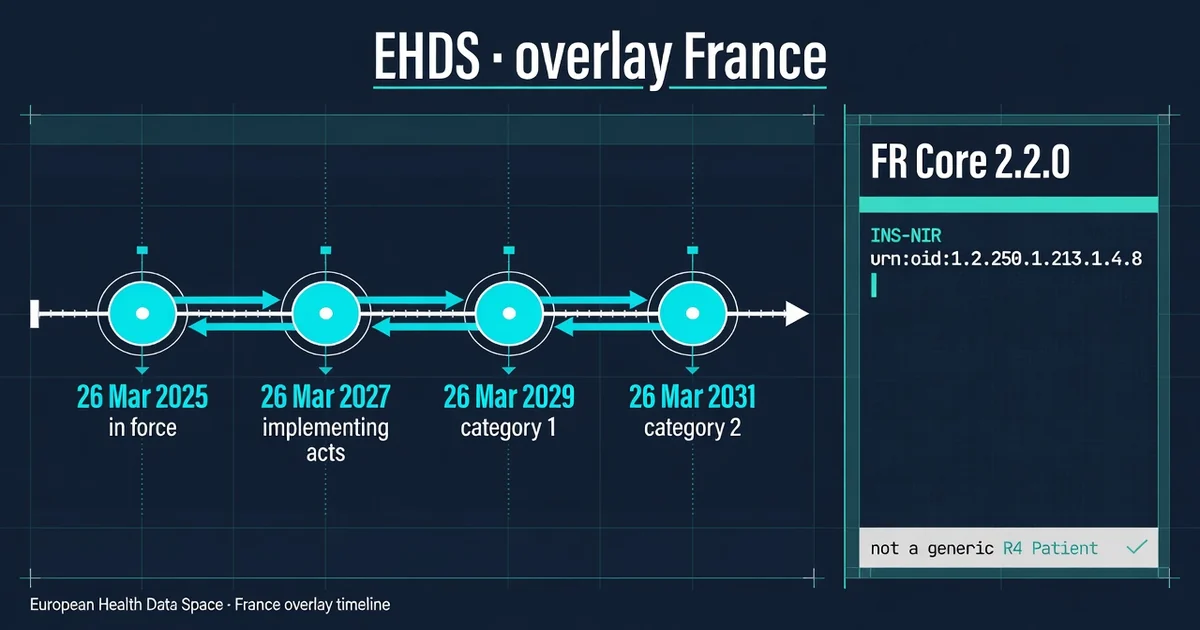
The EHDS has been in force since March 26, 2025. Implementing acts are due March 26, 2027. Category 1 applies to March 26, 2029. Overlay FR Core 2.2.0 and INS; do not send a generic Patient R4.
Two pages, two jobs
The English page EU Core and EHDS implementation pliers HL7 Europe Base/Core 2.0.0 and EEHRxF artifacts. This one is for a French-speaking product team which must make this European calendar coexist with the national overlay: FR Core 2.2.0, theNational Health Identity and the CI-SIS. This is not a translation. This is also not the page IPR manufacturer, chapter III.
Schedule to stick to backlog (not made up phase names)
To be pinned from regulation (EU) 2025/327 and the EHDS Commission page :
| Milestone | Date | What the product team is planning | What it is not |
|---|---|---|---|
| Entry into force | March 26, 2025 | The clock has started. Version dependencies (GI, identifiers, future actions). | “All CIOs already speak EEHRxF”. |
| Implementing acts / common specifications | March 26, 2027 | Art. 15 EEHRxF and Art. 36 common specifications. Pinch what the acts name. | A private XML called EEHRxF in 2026. |
| Category 1 (primary use) | March 26, 2029 | Patient summary, ePrescription, eDispensation for PGD in the field. | A Patient REST naked. |
| Category 2 (primary use) | March 26, 2031 | Imaging, test results (including laboratory), hospitalization reports. | A DICOM C-Store “so we are EHDS”. |
Secondary use (HealthData@EU, access organizations) is another pipeline: permits, datasets, secure environments. This is not the patient summary API. Don't build a "FHIR EHDS dump" and claim both.
Overlay France: FR Core 2.2.0 and INS
The pinner guide for French administrative resources is FR Core 2.2.0 (trial-use, active as of March 25, 2026), on FHIR R4. Official URL: https://hl7.fr/ig/fhir/core/ImplementationGuide/hl7.fhir.fr.core. Publication: https://hl7.fr/ig/fhir/core/. Package: hl7.fhir.fr.core#2.2.0. Interop'Santé / HL7 France indicate that national GIs (including ANS) must rely on FR Core, and that subsequent versions will aim for a legacy of HL7 Europe Base — announced alignment, not a Commission certificate.
The INS is not a Patient.id. The profile FR Core Patient INS (https://hl7.fr/ig/fhir/core/StructureDefinition/fr-core-patient-ins) fixed:
| Slice/artifact | identifier.system |
Role | Trap |
|---|---|---|---|
| INS-NIR | urn:oid:1.2.250.1.213.1.4.8 |
INS registration number obtained via teleservice INSi | Paste the NIR into Patient.id or in a system house |
| INS-NIA | urn:oid:1.2.250.1.213.1.4.9 |
Wait ID | Treat a NIA like a “VALI” NIR |
| INS-NIR-TEST / DEMO | urn:oid:1.2.250.1.213.1.4.10 / .4.11 |
Fixture games | Publish a real NIR in a gist |
| PPI | Establishment OID/URI | Local identifier | Believe that the IPP replaces the INS at the national border |
| IDNatPS | urn:oid:1.2.250.1.71.4.2.1 |
Professional | An application login |
| IDNatStruct | urn:oid:1.2.250.1.71.4.2.2 |
Structure | A SIRET stuck in Organization.id |
The invariant fr-core-1 profile Patient INS: if the identity status is VALI, at least one INS-NIR or INS-NIA (or TEST/DEMO slice) SHALL be present. A “qualified” identity without an INS slice is not compliant, even if the JSON is valid FHIR.
De-identified fixture (system TEST, not a person):
{
  "resourceType": "Patient",
  "meta": {
    "profile": ["https://hl7.fr/ig/fhir/core/StructureDefinition/fr-core-patient-ins"]
  },
  "identifier": [
    {
      "use": "official",
      "type": {
        "coding": [
          {
            "system": "https://hl7.fr/ig/fhir/core/CodeSystem/fr-core-cs-v2-0203",
            "code": "INS-NIR"
          }
        ]
      },
      "system": "urn:oid:1.2.250.1.213.1.4.10",
      "value": "EXEMPLE-INS-TEST-NON-NOMINATIF"
    }
  ]
}
Never publish an actual NIR. The INS repository v2.1 (decree of December 13, 2024) describes the referencing obligation; INSi teleservice remains the way to get identity, not a hand-entered field.
CI-SIS is not EEHRxF
The CI-SIS is the national ANS framework (CDA, IHE, FHIR, HL7 v2 depending on the component). EEHRxF is the exchange format that implementing acts 2027 must freeze for the six priority categories. A CI-SIS “synthesis” section or a CDA IPS-FR document is not, on its own, proof that a DPI will issue the appointed EEHRxF in 2027.
Until deeds, treat HL7 Europe Base/Core like implementable preview, not as a substitute for actions. Treat FR Core + INS as national constraint which remains on the European Patient : the INS is not replaced by patient-eu-core. A German KVNR, a Dutch BSN or a French NIR remain identifier.system Member State.
What the product team actually implements
- CapabilityStatement, not a slide. Declare FR Core and, for categories sold, IG Europe (EPS, MPD, laboratory, HDR) in
instantiates/supportedProfile. - Documents where the GI is a document. A patient summary is not a
GET /Patient/{id}. - INSi before cross-border upsert. Without identity
VALI, you export an IPP. This is not a Patient Summary EHDS. - Terminology. The EEHRxF logic models link SNOMED CT, LOINC, ICD, ATC. A Observation "code local only" will fail semantic checks.
- Two backlogs. Overlay France (INS, CI-SIS, FR Core) and EHDS calendar (2027 / 2029 / 2031). A single milestone “we’re doing FHIR” mixes the two.
What this page is not
This is not an EHDS conformity assessment, not a CE marking, not a DPI system certificate, not legal advice. Implementing FR Core 2.2.0 or HL7 Europe Base/Core does not make a product “EHDS certified”. The 2027 Acts may still name other artifacts. I do not represent the Commission, the ANS, or Interop'Santé. Nothing here is clinical advice.
If you need the interoperability architecture (FR Core + Europe Base/Core on an existing HIS), it is interoperability in digital health. For a bounded spike, use the contact with project intention.