



US Core and TEFCA: implementing USCDI on a still-hybrid national network
US Core 9.0.0 is the FHIR profile layer for USCDI v6. TEFCA remains document exchange plus Facilitated FHIR — 11 QHINs, 71,000+ sites and 464 million documents by end of 2025.
Ala Ben Aicha
Direct answer
US Core is the FHIR profile layer for USCDI. TEFCA is still hybrid: documents plus Facilitated FHIR. By end of 2025 the ONC fact sheet counted 11 QHINs, 71,000+ sites and 464 million documents exchanged.
US Core 9.0.0: the IG to pin
US Core Implementation Guide 9.0.0 (STU 9) is the current published US Realm core, generated 31 May 2026, on FHIR R4. Official URL: http://hl7.org/fhir/us/core/ImplementationGuide/hl7.fhir.us.core. Published home: https://www.hl7.org/fhir/us/core/. Package: hl7.fhir.us.core#9.0.0.
The US Core USCDI page maps US Core versions to USCDI versions. US Core 9.0.0 maps to USCDI v6. USCDI is the ONC data-class list (what must be available). US Core is the HL7 FHIR profile and search contract (how it is represented). They are not synonyms. Certification programmes name a USCDI version; your FHIR server names a US Core package. Keep both in the architecture decision record.
Country-specific class for this page: USCDI Patient Demographics, implemented as US Core Patient (http://hl7.org/fhir/us/core/StructureDefinition/us-core-patient). Race and ethnicity extensions are USCDI/US Core artefacts; they do not belong on an EU Core Patient. See EU Core vs US Core if you ship both markets.
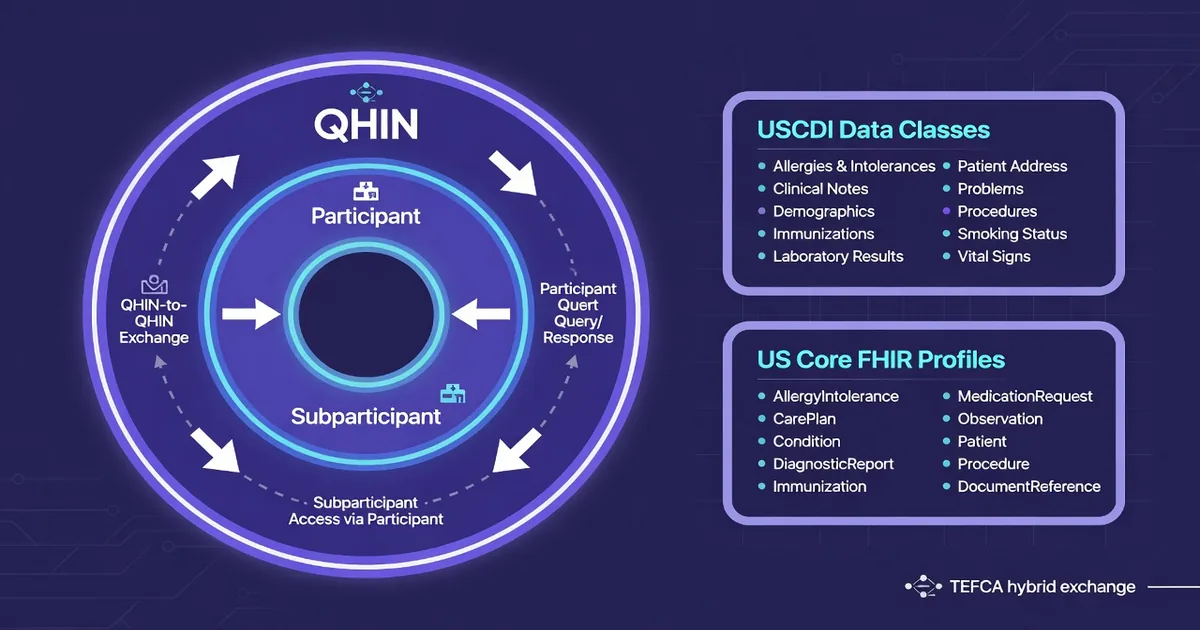
US Core profiles versus USCDI classes
A one-line mapping is enough to stop a product manager treating “USCDI Allergies” as a custom resource.
| USCDI class (examples) | US Core profile to implement | Notes |
|---|---|---|
| Patient Demographics | US Core Patient | Identifier slices, USCDI extensions; not a European national ID |
| Allergies and Intolerances | US Core AllergyIntolerance | Must-support substance and reaction elements as in the IG |
| Medications | US Core MedicationRequest / Medication | RxNorm bindings in US Core, not ATC/PZN |
| Problems | US Core Condition Problems and Health Concerns | Problems are not the same profile as encounter diagnosis in every version — read STU 9 |
| Laboratory | US Core Laboratory Result Observation | LOINC; report context still needs DiagnosticReport where the IG says so |
| Vital Signs | US Core vital-sign Observation profiles | Separate profiles per vital, not one generic Observation |
| Immunizations | US Core Immunization | CVX / NDC as bound in the IG |
| Clinical Notes / documents | US Core DocumentReference (and related note profiles) | This is also the TEFCA document path |
The US Core IG’s CSV/Excel USCDI map is the authoritative element-level table. Do not invent extra must-support flags.
TEFCA numbers from the 11 February 2026 ONC fact sheet
ASTP/ONC’s fact sheet Data Liquidity, Affordability, and Access: The History & Growth of TEFCA (11 February 2026) is the source for these figures — not a vendor dashboard:
- Approximately 10 million documents exchanged across TEFCA before 2025
- 464 million documents exchanged by the end of 2025
- 11 QHINs
- Over 71,000 sites or organisations participating
Those are document-exchange volumes on a network of networks. They are not proof that 464 million native FHIR Bundles moved. The same fact sheet lists document exchange, FHIR APIs, directory and lookup services, and USCDI as the tools TEFCA uses together.
QHIN versus Participant versus Subparticipant
Keep the three roles separate when you draw the sequence diagram. The fact sheet and the Common Agreement use this stack:
| Role | Who | What they do |
|---|---|---|
| QHIN | Designated Qualified Health Information Network | Connects to other QHINs; provides nationwide connectivity under the Common Agreement |
| Participant | Organisation that connects to a QHIN (health system, HIN, payer, federal agency, …) | Signs Terms of Participation; appears in the RCE Directory |
| Subparticipant | Provider, app or other node that connects through a Participant | Same exchange purposes, one hop further from the QHIN |
The Recognized Coordinating Entity (RCE) is The Sequoia Project. QHIN-to-QHIN traffic is TEFCA exchange. Traffic that never leaves a QHIN’s internal network is not automatically TEFCA exchange. The existing TEFCA explainer covers exchange purposes (Treatment, Payment, Operations, IAS, Public Health, Government Benefits Determination); this page does not repeat that list.
Facilitated FHIR versus document exchange
TEFCA launched on IHE document query and message delivery (C-CDA and other documents). The RCE FHIR Roadmap and QTF then added Facilitated FHIR: the QHIN still does patient discovery and endpoint location; the Participant or Subparticipant then calls the FHIR API directly (UDAP/FAST security), rather than pulling a document through the QHIN.
That is not “all TEFCA payloads are native FHIR”. QHIN-to-QHIN FHIR and end-to-end brokered FHIR are later roadmap stages. A production design in 2026 still has to:
- Accept document responses (C-CDA / DocumentReference)
- Optionally speak Facilitated FHIR against US Core
- Record which path a given partner actually supports in the directory
If you only implement US Core REST and refuse documents, you will fail partners who are live on TEFCA document exchange.
HIPAA is a parallel constraint, not a TEFCA checkbox
TEFCA participation does not replace the HIPAA Privacy and Security Rule work on BAAs, minimum necessary, and audit logging. Some TEFCA actors are not HIPAA covered entities; the Common Agreement still imposes privacy and security terms. Design the FHIR audit trail for both.
What this is not
This page is not ONC certification, not a QHIN designation, not a TEFCA onboarding letter, and not legal advice. Implementing US Core 9.0.0 does not make a product certified health IT. The 464 million figure is ONC’s end-2025 document count, not a claim about this site, and not a claim that those documents were FHIR resources. Nothing here is clinical advice.
Related reading
- Network overview: TEFCA explained
- Profile contrast: EU Core vs US Core
- Country map: FHIR implementation guides by country
For US Core mapping on a hybrid engine, use digital health interoperability.